The Hub

How might we build smart homes of the future?

The Hub

How might we build smart
homes of the future?

The Hub

How might we build smart homes of the future?

The Hub

How might we build smart homes of the future?

The Hub

How might we build smart
homes of the future?

Role

UX Designer

Duration

3 months

Responsibilities

Conducting user interviews

Prediction analysis

Data gathering and analysis

Exploring future scenarios

Tools

Adobe creative suite

Project Overview

As of 2017, The life expectancy of an average Indian citizen was 68.78 years. That is about 825 months, or 25,173 days.
If we were to strip away all of the time we spend on useless things (waiting in queues, watching movies, stuck in traffic, washing dishes, etc) we have about 9 years left to actually do the things that we actually want to do.
Our phones and laptops might be interconnected with one another, but what happens when you’re out of town and there’s no one to take care of the home? or when you’re cooking at home and don’t have enough ingredients to make something, or just the everyday routine we follow?
Why mustn’t there be connectivity between them?
Could our lives become easier if we made smart homes a reality?

Scope

Problem

Users spend a lot of time on chores around the house, which in turn reduces their productivity and flow.

User goals

Formulate a hypothetical smart home system using research of future technologies such as AI, AR, VR & IoT.

Must be simple and handle everyday chores for you in a subtle and non-intrusive way.

Product goals

Unification of the home. Must be able to communicate and do various tasks which need to be updated in real-time.

Ability to provide information when the user is on the move.

Research

The main research for this project was done through prediction analysis and combining solutions through What If scenarios. 

Prediction analysis

There were a lot of discussions based on where the future would lead us. Insights were drawn from the conversations which led us to predict what is to come, and how to go about predicting the future based on current trends. 

This was done by asking the 4 main questions in understanding predictive behaviors:

1. What is happening?
2. Why is it happening?
3. What is likely to happen?
4. What is the best course of action?

Based on the information that I gathered so far, I started to create a chart of the current market scenario and formulating various outcomes.

Thought log

There are so many different technologies that are at play here, but in order to build a product for a Smart Home, it needs to be able to communicate with these other devices.

Routine map

Understanding routines

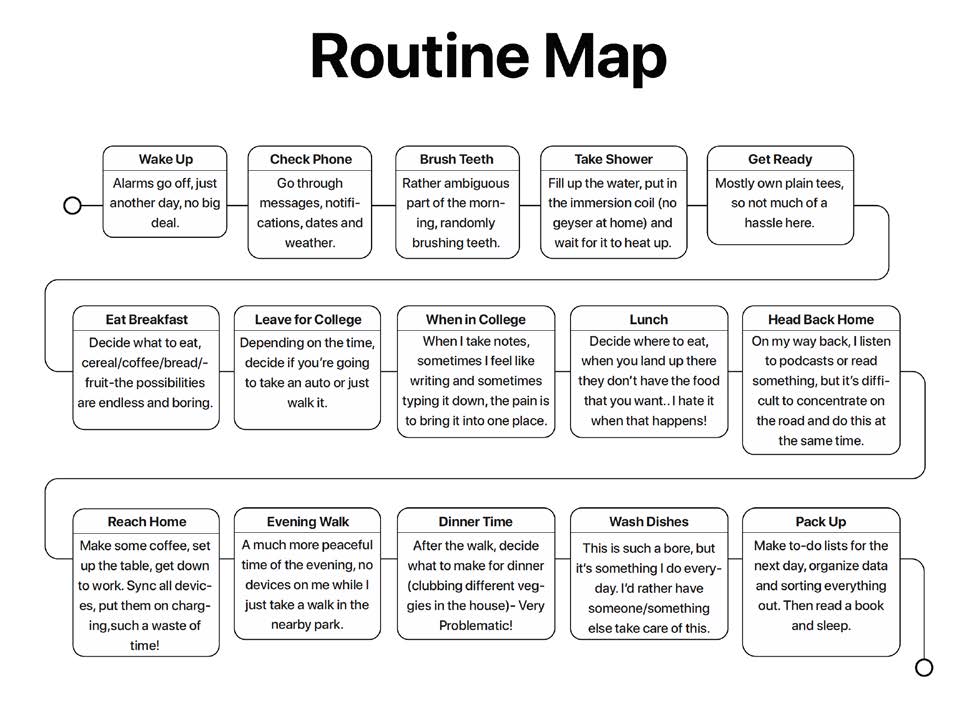
In order to create a new system, one needs to break down the one that is existing, observe all of the elements and see how they can be fit into the new one.


So, I began to create a routine map of my day to day activities in order to see how things go about. This helped in understanding the areas which are problematic and needed some attention.
What makes a home?

Lets presume you're not at home and a fuse goes off or maybe you leave something on which wasn’t supposed to be.

If your house is considered as an extension to yourself, it should be smart enough to handle these problems for you.

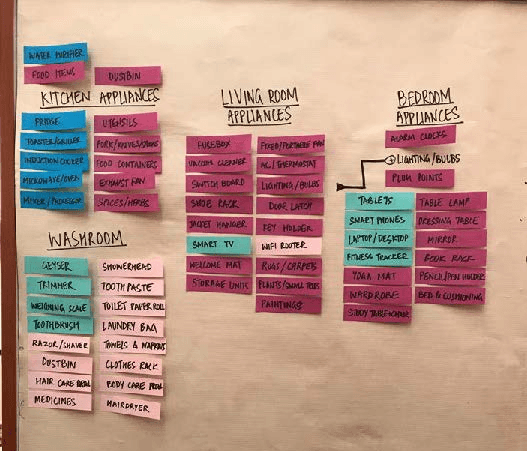
So it was quite evident that along with charting out my daily routine, I’d also need to map out the basic elements that make up a house.

Thought log

"After dividing the house into various elements, they can be joined together in new ways to solve very different problems."

Ex: A door mat and a latch are two items, but if the door mat becomes the latch, one can just walk into their house without dealing with keys.

Physical actions

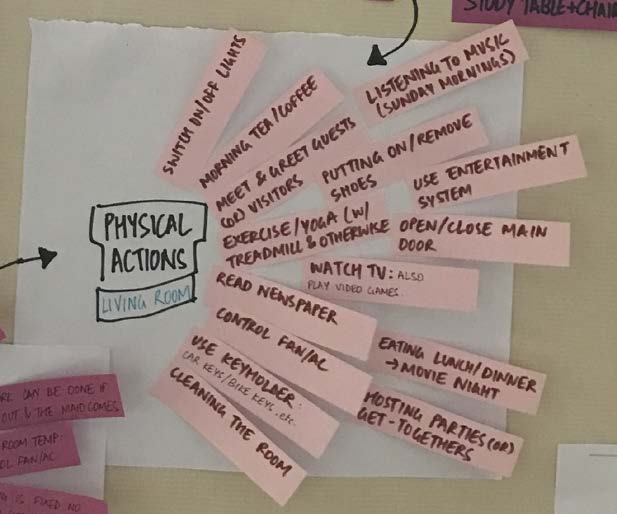
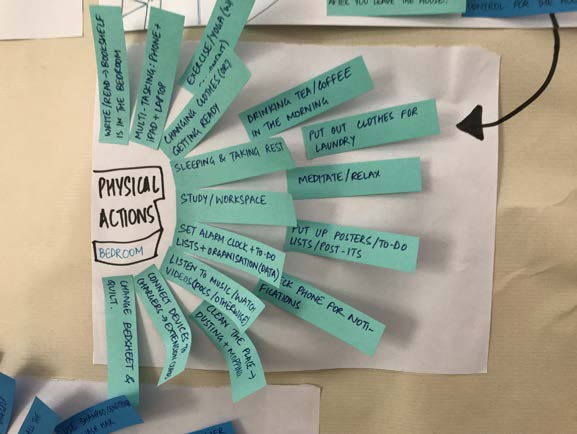
The next exercise was to understand the physical actions which are taken in various rooms in our home.

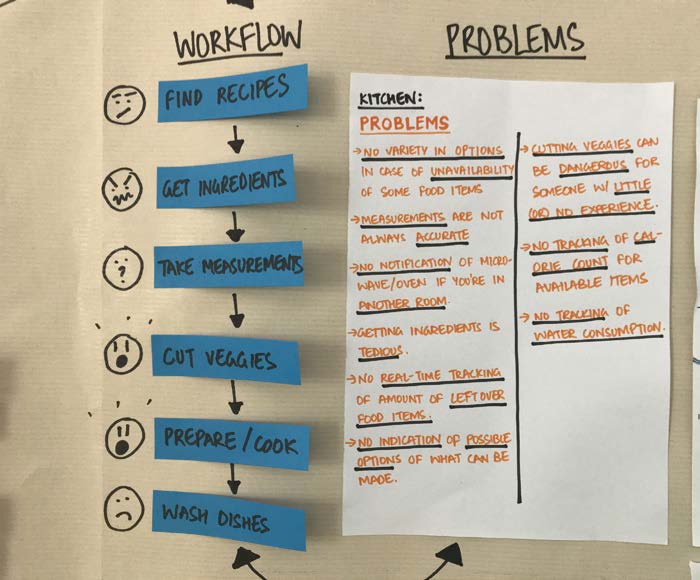
After writing down the physical actions on sticky notes, I used affinity diagramming to identify themes and problem areas.

Identifying problem areas

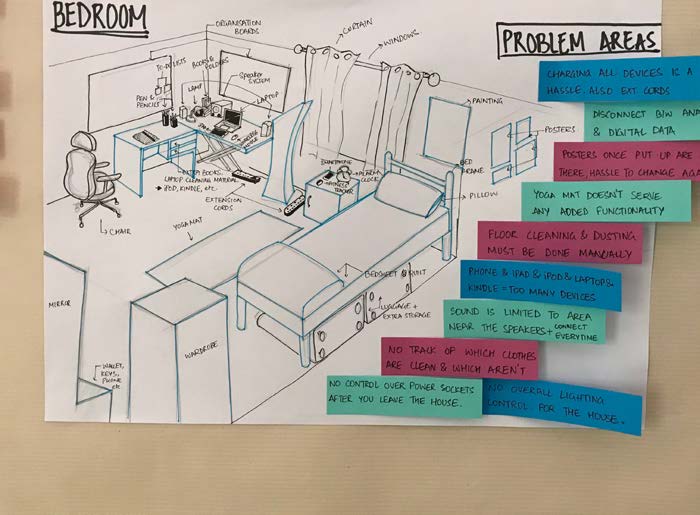
Now that I had a clear(er) understanding of the elements of what make up a home, and the physical actions a user would perform in their home, I explored what potential problem areas could arise on a day-to-day basis.

What can be done to improve the issues we ignore everyday? Is there a better way to solve these unaddressed problems?

Analysis

Understanding the data that was gathered so far to create future scenarios.

Gathering data

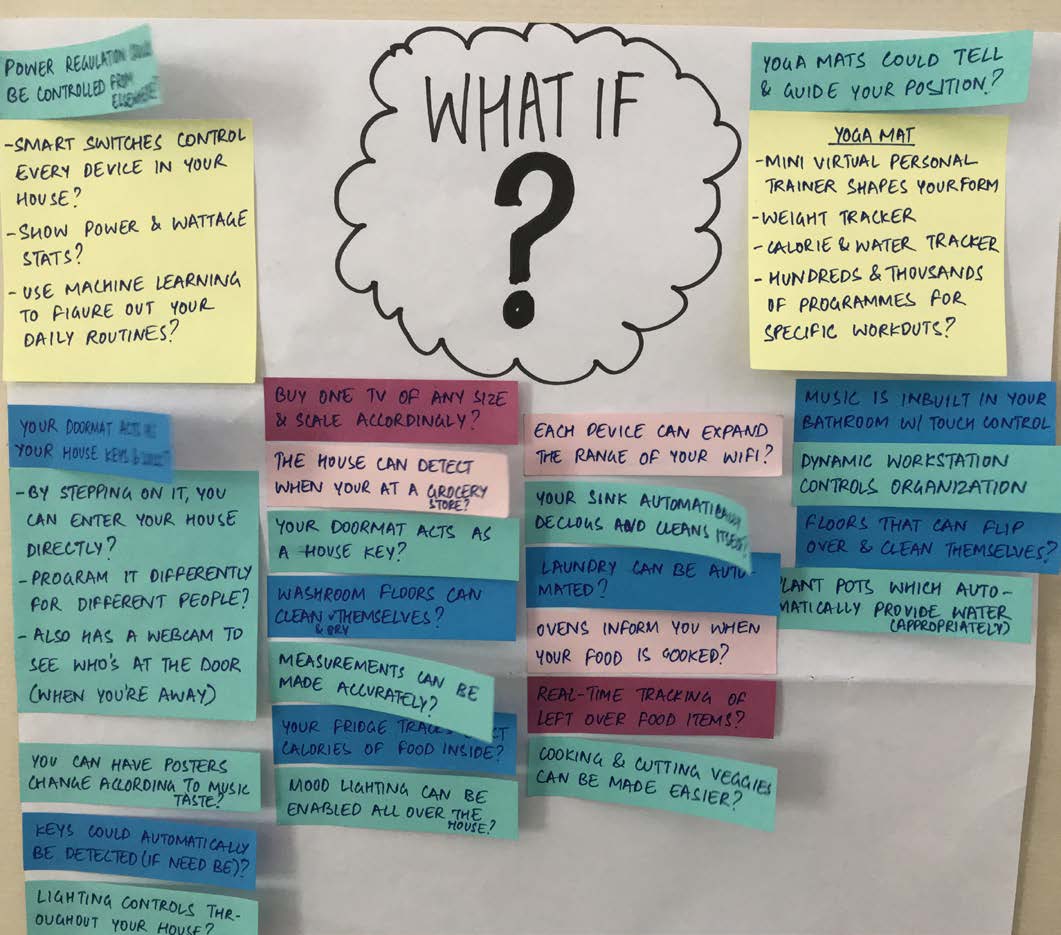
'What if' scenarios

These were some of the scenarios that we came up with:

  • What if there were Smart Switches which could be controlled wirelessly and while you’re away from home?

  • What if TV sets weren’t physical but rather holographic projections and could be scaled according to your wishes?

  • What if wireless charging was enabled for all
    sorts of devices and you’d just need to be in the vicinity to charge your devices?

  • What if Yoga Mats could detect your weight,
    give you diet plans and accordingly co-ordinate with your kitchen to check for supplies?

  • What if we had interactive posters which could change according to your own music taste?

Thought log

"The solution for the smart home doesn't need to be bound to the home only, it impacts the other areas of life as well.

This product would have portability and can replace all the devices we currently own. It would need proximity and connectivity  to expand the features to show relevant options according to your location."
Feature forecasting

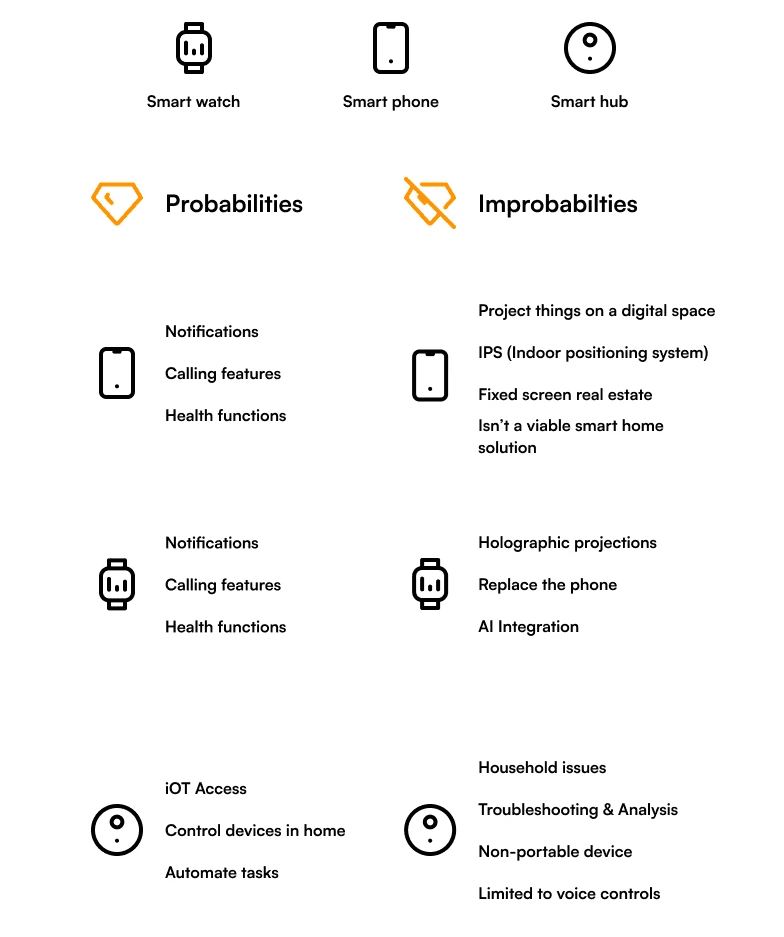
Understanding prospective trends to forecast probabilities and improbabilities.

Prospective trend analysis

Another process conducted was to identify several key features that are likely to become standard in the near future:

  • Smart watches and phones:
    Expect richer interactions through enhanced notifications, robust calling features, and health monitoring tools. These devices will become more interconnected with home systems, providing seamless control and updates.

  • Smart hubs:
    These will likely evolve into central control units for home automation, offering intuitive interfaces to manage and automate household tasks through IoT integration.

However, some technologies might not take off as expected due to current technical and practical limitations:

  • Immersive projections and holography:
    These are still in nascent stages and may not be viable for everyday use in the immediate future.

  • Fixed screens and standalone devices:
    As mobile technology continues to dominate, the role of fixed screens and non-portable devices in smart homes is becoming less central.

  • AI and voice controls:
    Full AI integration and sophisticated voice controls are developing but may face slow adoption due to their complexity.
Ideation

Product sketches

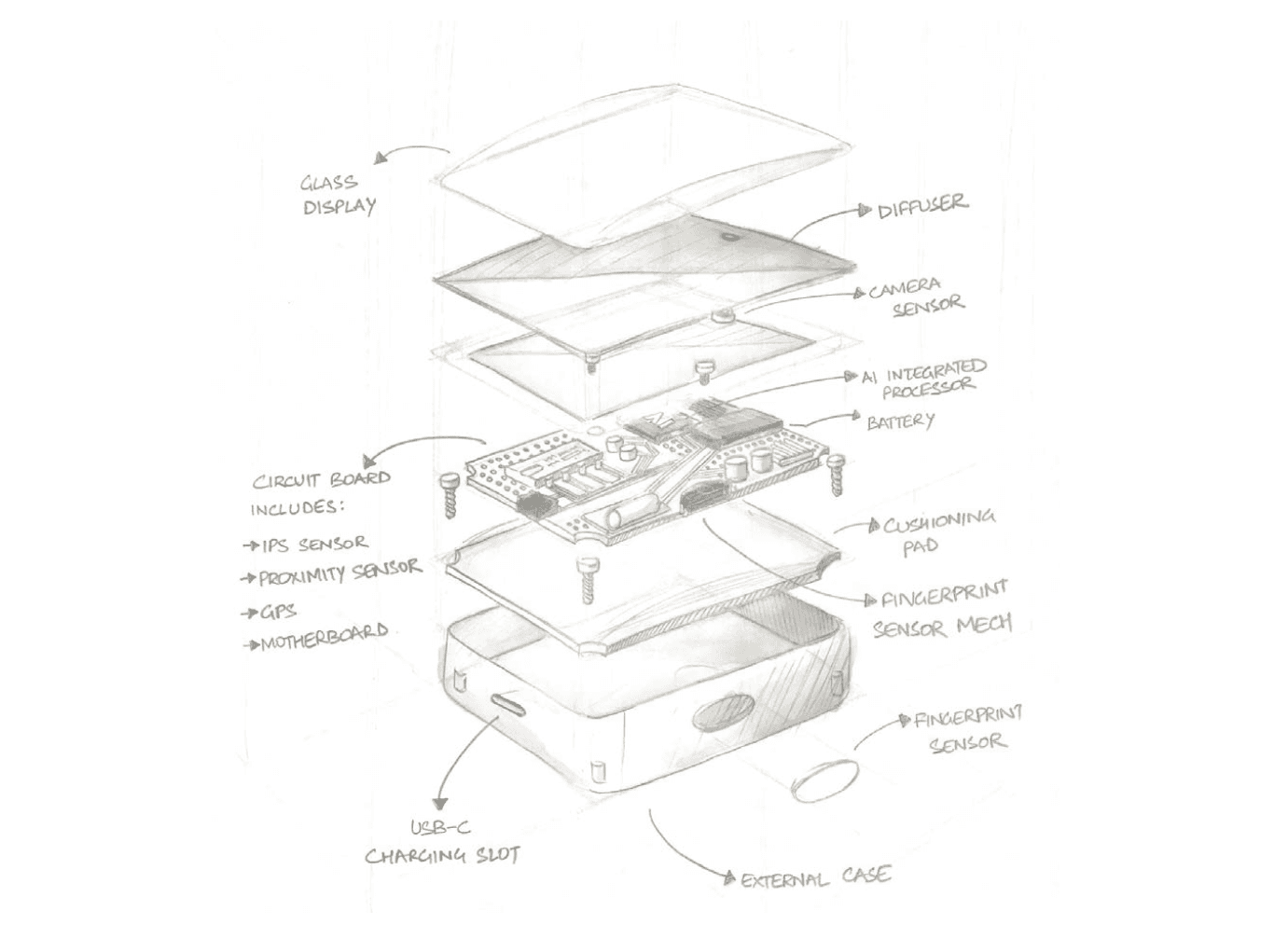
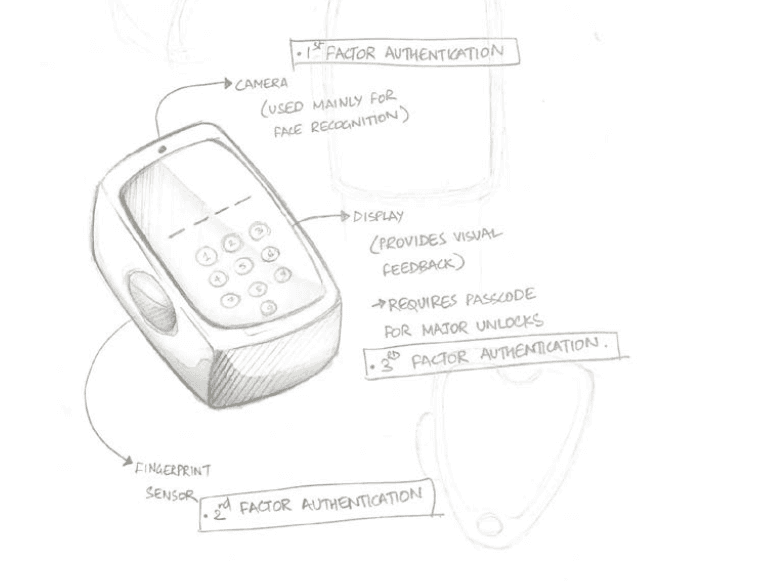
The watch acts as a portable control center for smart homes, offering secure synchronization with household devices, user-specific customization, and both USB-C and wireless charging. Its design integrates advanced AI and sensor technology for an intuitive, connected living experience.

These were some of the sketches from the project. It shows ideas about the features that would be required for a device like this to exist, and what it could look like.

I went with the idea of a watch because of it's portability, but also for the charging station of this watch to become a centralized hub that could be used and controlled as a dashboard.
Future possibilities

Smart watches

Smart watches

Smart watches

Timeline

We’re headed towards a future where augmentation of information will help us in understanding our world a lot better.

Until we reach that stage, we have physical screens which could be cast with your device in order to view/control information/functions.

We’re headed towards a future where augmentation of information will help us in understanding our world a lot better.

Until we reach that stage, we have physical screens which could be cast with your device in order to view/control information/functions.

We’re headed towards a future where augmentation of information will help us in understanding our world a lot better.

Until we reach that stage, we have physical screens which could be cast with your device in order to view/control information/functions.

We’re headed towards a future where augmentation of information will help us in understanding our world a lot better.

Until we reach that stage, we have physical screens which could be cast with your device in order to view/control information/functions.

We’re headed towards a future where augmentation of information will help us in understanding our world a lot better.

Until we reach that stage, we have physical screens which could be cast with your device in order to view/control information/functions.

Screen casting

Screen Casting would allow you to take over other screens in order to view your information/ data in a much better fashion. We’ve been using screen casting ever since projectors came about, but now it’s gone wireless.

Although, the Watch + ScreenCast combination would only last until we reach a stage where augmented information can be viewed anywhere, without the restriction of a physical screen being present.

Once we move on to augmented spaces, we won’t be stuck on two-dimensionality of information viewing, but rather 3- dimensions of it. Adding this extra dimension allows for more creativity in the mapping of data in our daily lives.

Screen Casting would allow you to take over other screens in order to view your information/ data in a much better fashion. We’ve been using screen casting ever since projectors came about, but now it’s gone wireless.

Although, the Watch + ScreenCast combination would only last until we reach a stage where augmented information can be viewed anywhere, without the restriction of a physical screen being present.

Once we move on to augmented spaces, we won’t be stuck on two-dimensionality of information viewing, but rather 3- dimensions of it. Adding this extra dimension allows for more creativity in the mapping of data in our daily lives.

Screen Casting would allow you to take over other screens in order to view your information/ data in a much better fashion. We’ve been using screen casting ever since projectors came about, but now it’s gone wireless.

Although, the Watch + ScreenCast combination would only last until we reach a stage where augmented information can be viewed anywhere, without the restriction of a physical screen being present.

Once we move on to augmented spaces, we won’t be stuck on two-dimensionality of information viewing, but rather 3- dimensions of it. Adding this extra dimension allows for more creativity in the mapping of data in our daily lives.

Screen Casting would allow you to take over other screens in order to view your information/ data in a much better fashion. We’ve been using screen casting ever since projectors came about, but now it’s gone wireless.

Although, the Watch + ScreenCast combination would only last until we reach a stage where augmented information can be viewed anywhere, without the restriction of a physical screen being present.

Once we move on to augmented spaces, we won’t be stuck on two-dimensionality of information viewing, but rather 3- dimensions of it. Adding this extra dimension allows for more creativity in the mapping of data in our daily lives.

Screen Casting would allow you to take over other screens in order to view your information/ data in a much better fashion. We’ve been using screen casting ever since projectors came about, but now it’s gone wireless.

Although, the Watch + ScreenCast combination would only last until we reach a stage where augmented information can be viewed anywhere, without the restriction of a physical screen being present.

Once we move on to augmented spaces, we won’t be stuck on two-dimensionality of information viewing, but rather 3- dimensions of it. Adding this extra dimension allows for more creativity in the mapping of data in our daily lives.

Why a watch?

Watches are considered to be the most intuitive wearable tech. This is because we’ve had watches on for the longest times (with bouts of evolution here and there) but now you’re able to control a lot of other things along with it.

XR (Augmented reality)

XR (Augmented reality)

XR (Augmented reality)

Timeline
Timeline
Timeline
Timeline

Once Augmented Reality would’ve reached the mass consumer market and they start adapting to it on a massive level, then we’ll see a huge difference in the way we communicate with our everyday surroundings.

Screen casting
Screen casting
Screen casting
Screen casting

We’re at a stage where we can view this content on our devices, and walk around them as well. But there is still an obstruction of the device itself. You can’t touch things or even interact with them without the help of the screen. 

XR Headsets have been popping up everywhere but we’re still in a developmental stage and we haven’t reached a consumer-ready product.

For now, it’s just developers who have been testing the possibilties of XR but have had great results so far.

We’re at a stage where we can view this content on our devices, and walk around them as well. But there is still an obstruction of the device itself. You can’t touch things or even interact with them without the help of the screen. 

XR Headsets have been popping up everywhere but we’re still in a developmental stage and we haven’t reached a consumer-ready product.

For now, it’s just developers who have been testing the possibilties of XR but have had great results so far.

We’re at a stage where we can view this content on our devices, and walk around them as well. But there is still an obstruction of the device itself. You can’t touch things or even interact with them without the help of the screen. 

XR Headsets have been popping up everywhere but we’re still in a developmental stage and we haven’t reached a consumer-ready product.

For now, it’s just developers who have been testing the possibilties of XR but have had great results so far.

We’re at a stage where we can view this content on our devices, and walk around them as well. But there is still an obstruction of the device itself. You can’t touch things or even interact with them without the help of the screen. 

XR Headsets have been popping up everywhere but we’re still in a developmental stage and we haven’t reached a consumer-ready product.

For now, it’s just developers who have been testing the possibilties of XR but have had great results so far.

We’re at a stage where we can view this content on our devices, and walk around them as well. But there is still an obstruction of the device itself. You can’t touch things or even interact with them without the help of the screen. 

XR Headsets have been popping up everywhere but we’re still in a developmental stage and we haven’t reached a consumer-ready product.

For now, it’s just developers who have been testing the possibilties of XR but have had great results so far.

Why XR?
Why XR?
Why XR?
Why XR?

The possibilities of XR are endless. This technology has the potential of revolutionizing almost every industry which adapts it. 

Mixed Reality in a SmartHome scenario would enable you to solve most of your home issues in quite interesting ways.

BCI (Brain controlled interfaces)

BCI (Brain controlled interfaces)

BCI (Brain controlled interfaces)

Timeline
Timeline
Timeline
Timeline

Once Augmented Reality would’ve reached the mass consumer market and they start adapting to it on a massive level, then we’ll see a huge difference in the way we communicate with our everyday surroundings.

Screen casting
Screen casting
Screen casting
Screen casting

If we could somehow enable others to see the exact same image of what we want to convey, then it’ll be the best & fastest way to communicate.

Of course, by the time this tech comes we’ll have improvements in other areas as well: Wearables & AR.

But all of these things put together could truly redefine what a Smart Home is, & break the boundaries of what makes us human.

If we could somehow enable others to see the exact same image of what we want to convey, then it’ll be the best & fastest way to communicate.

Of course, by the time this tech comes we’ll have improvements in other areas as well: Wearables & AR.

But all of these things put together could truly redefine what a Smart Home is, & break the boundaries of what makes us human.

If we could somehow enable others to see the exact same image of what we want to convey, then it’ll be the best & fastest way to communicate.

Of course, by the time this tech comes we’ll have improvements in other areas as well: Wearables & AR.

But all of these things put together could truly redefine what a Smart Home is, & break the boundaries of what makes us human.

If we could somehow enable others to see the exact same image of what we want to convey, then it’ll be the best & fastest way to communicate.

Of course, by the time this tech comes we’ll have improvements in other areas as well: Wearables & AR.

But all of these things put together could truly redefine what a Smart Home is, & break the boundaries of what makes us human.

If we could somehow enable others to see the exact same image of what we want to convey, then it’ll be the best & fastest way to communicate.

Of course, by the time this tech comes we’ll have improvements in other areas as well: Wearables & AR.

But all of these things put together could truly redefine what a Smart Home is, & break the boundaries of what makes us human.

Why BCI?
Why BCI?
Why BCI?
Why BCI?

This tech aspires to link thought to action, potentially allowing brain signals to initiate tasks like brewing coffee, showcasing the brain's low-energy, high-efficiency prowess. The challenge lies in decoding the brain's communication system with the body.